Retinoids Explained: The Gold Standard Ingredient for Preventing Skin Ageing

Retinoids are vitamin A derivatives used in professional treatments and home skincare to improve the appearance of fine lines, uneven pigmentation, rough texture and blemishes.
Rather than working only on the surface, retinoids influence how skin cells develop and behave. This allows a well-chosen retinoid to address several concerns within the same routine, which is why vitamin A has become one of the most established ingredients used for visible skin ageing.
However, retinoids are not suitable for every person, every skin condition or every stage of life. The strength, formulation and frequency of use all need to be considered. Starting with a product that is too strong, applying it too often or combining it with several other active ingredients can cause dryness, inflammation and damage to the skin barrier.
What Are Retinoids?
Retinoid is the collective name for a family of natural and synthetic vitamin A derivatives.
This family includes:
-
Retinyl esters, such as retinyl palmitate
-
Retinol
-
Retinaldehyde, usually shortened to retinal
-
Retinoic acid, including prescription tretinoin
-
Synthetic prescription retinoids, such as adapalene and tazarotene
-
Cosmetic retinoid derivatives, including hydroxypinacolone retinoate
Retinol is therefore one type of retinoid, but not every retinoid is retinol.
The distinction matters because each form follows a different pathway within the skin. Some require several conversion stages before they become active, while others act more directly. Products that work closer to the active form may produce faster or more pronounced effects, but they can also carry a greater risk of irritation.
Why Are Retinoids Considered The Gold Standard For Skin Ageing?
Prescription tretinoin has been studied extensively for photoaged skin and remains one of the best-established topical options for improving fine wrinkles, uneven pigmentation and rough texture.
Cosmetic retinoids, including retinol and newer vitamin A derivatives, provide non-prescription alternatives. Their activity varies by ingredient, concentration and formulation, so they should not all be treated as interchangeable.
The wider retinoid family is valued because it can help with several visible skin concerns at the same time:
-
Fine lines and wrinkles
-
Uneven skin tone
-
Sun-related discolouration
-
Rough or irregular texture
-
Congested pores
-
Some forms of acne
-
Dullness and reduced radiance
Retinoids are often described as anti-ageing ingredients, but they cannot stop biological ageing or replace lost facial volume. Their role is to support healthier cell behaviour and improve visible changes within the skin over time.
Daily broad-spectrum sun protection remains the most important step for limiting avoidable photoageing.
How Do Retinol And Retinoids Work?
 Retinoids communicate with receptors inside skin cells. In simple terms, they give cells instructions that affect renewal, pigmentation and structural activity.
This is different from applying a basic moisturiser, which primarily helps the surface retain water, or using an exfoliating acid, which loosens dead cells from the outer layers.
Regulating Skin-Cell Renewal
Skin cells are continually produced, moved towards the surface and eventually shed.
This process tends to slow and become less orderly with age and cumulative environmental damage. Retinoids help regulate cell development and shedding, which can make the skin look smoother and more even.
This effect is often described as increasing cell turnover. However, retinoids are not simply exfoliants. Their activity involves communication with living cells rather than only removing material from the surface.
Improved cell regulation may also reduce the accumulation of dead cells within follicles, which is why some retinoids are used for congested and acne-prone skin.
Supporting Collagen-Related Activity
Collagen provides strength and structural support within the dermis. Its production gradually declines with age, while ultraviolet exposure contributes to the breakdown of existing collagen fibres.
Retinoids can support processes associated with collagen production and reduce some of the activity involved in collagen degradation.
With consistent, appropriate use, this may soften the appearance of fine lines and improve the look of skin texture and firmness. These changes develop gradually and depend on the type of retinoid, the formulation, how consistently it is used and the condition of the skin.
Improving Uneven Pigmentation
Retinoids can help regulate skin renewal and the distribution of pigment. This makes them relevant to concerns such as sun-related discolouration, post-inflammatory marks and an uneven-looking complexion.
Pigmentation should still be assessed carefully. New, changing, raised, bleeding or irregular pigmented lesions require medical assessment rather than cosmetic treatment.
Irritation can also worsen post-inflammatory hyperpigmentation, particularly in darker skin tones. A stronger product is therefore not always the better choice.
Helping To Keep Pores Clear
Retinoids can help prevent abnormal build-up of skin cells within the follicle. Prescription retinoids are widely used within acne treatment for this reason.
Cosmetic retinoids may support blemish-prone skin, but persistent, painful, inflammatory or scarring acne should be assessed by a suitable medical professional.
Retinol Vs Retinoids: What Is The Difference?
Retinol is a cosmetic vitamin A derivative. Before it can fully influence retinoic acid receptors, the skin must convert it into the active form, retinoic acid.
Other vitamin A derivatives require fewer or more conversion stages. The number of stages can affect how quickly a product works, although formulation quality, concentration and skin tolerance are also important.
The Vitamin A Conversion Ladder
 The traditional conversion pathway is:
Retinyl esters → retinol → retinaldehyde → retinoic acid
Retinyl Esters
Retinyl palmitate and other retinyl esters are several conversion stages away from retinoic acid.
They are usually considered gentler than retinol or retinaldehyde. Their milder activity can make them suitable for introductory products, masks or routines designed for people who are concerned about irritation.
The trade-off is that they tend to act more gradually.
Retinol
Retinol is converted first into retinaldehyde and then into retinoic acid.
It is widely used in non-prescription skincare and is available in many strengths and product types. Retinol can be effective, but its tolerance varies. Concentration alone does not reveal how strong a finished product will feel because stability, delivery systems and supporting ingredients also affect performance.
Retinaldehyde
Retinaldehyde, usually called retinal, requires one conversion stage to become retinoic acid.
It sits closer to the active form than retinol and may act more quickly. It can still cause dryness and irritation, particularly when introduced too frequently.
Retinoic acid
Tretinoin is retinoic acid and does not require conversion within the skin.
In the UK, tretinoin is a prescription-only medicine. Its direct activity can make it highly effective, but dryness, redness, peeling and irritation are common, particularly during the adjustment period.
Prescription retinoids should be used according to the instructions provided by the prescriber.
Where Hydroxypinacolone Retinoate Fits
Hydroxypinacolone retinoate is a cosmetic retinoid derivative used within several Juliette Armand formulations. It is designed to interact with retinoid receptors without following the complete traditional conversion pathway required by retinol.
Percentages of different retinoids cannot be compared directly. For example, a product containing 1% of one retinoid ingredient should not automatically be considered equivalent to a product containing 1% retinol or tretinoin.
The percentage is only meaningful when considered alongside the exact ingredient, delivery system, complete formulation and directions for use.
Juliette Armand Retinoid Products: Choosing An Appropriate Level
Retinoid skincare should be selected according to the person’s previous vitamin A experience, skin condition, concerns and tolerance.
Moving directly to the highest percentage is unlikely to produce better results if the skin becomes inflamed and the product cannot be used consistently.
Professional Treatment: Elements Grand Retinoid Therapy
 Elements Grand Retinoid Therapy is a professional cosmetic protocol for use by trained practitioners.
The protocol combines different retinoid concentrations with growth factors, vitamin C, peeling and cellular-stimulating stages. The varying strengths allow the practitioner to focus resurfacing on areas that require more targeted treatment rather than applying an identical intensity across the entire face.
It is intended to improve the appearance and texture of ageing or photodamaged skin while supporting hydration and firmness.
Because this is a professional protocol, client selection, consultation, contraindications, preparation, application and aftercare should be managed by an appropriately trained practitioner.
Professional retinoid resurfacing should not be treated as an ordinary facial or replicated at home using several strong retinoid products.
Gentle Introduction: Retinyl Palmitate Masks
Retinyl palmitate is a mild, stable retinyl ester. It requires several conversion stages before reaching retinoic acid and generally acts more gradually than retinol or stronger retinoid derivatives.
Masks containing retinyl palmitate may suit adults who have not previously used vitamin A and want a gentle introduction. They may also be considered where the aim is to support texture and conditioning without immediately moving to a concentrated serum.
Lifting Mask
 The Juliette Armand Lifting Mask is a facial and neck mask intended to improve the appearance of skin texture and firmness.
It is suitable for all skin types and can be incorporated into a routine where the main concerns include reduced firmness, roughness or a tired-looking complexion.
The product’s lifting description refers to the temporary cosmetic appearance and feel of the skin. It should not be presented as producing the same structural result as a surgical or medical lifting procedure.
Chlorophyll Firming Mask
 The Juliette Armand Chlorophyll Firming Mask is intended for combination and oily skin.
It helps cleanse and refresh the skin, reduce the appearance of excess oil, unclog pores and improve the feel of the skin’s texture. It may be a more suitable introductory mask for people whose ageing concerns are accompanied by congestion or oiliness.
Although these masks contain a gentler vitamin A derivative, they should still be introduced carefully where the skin is highly reactive or already exposed to other resurfacing ingredients.
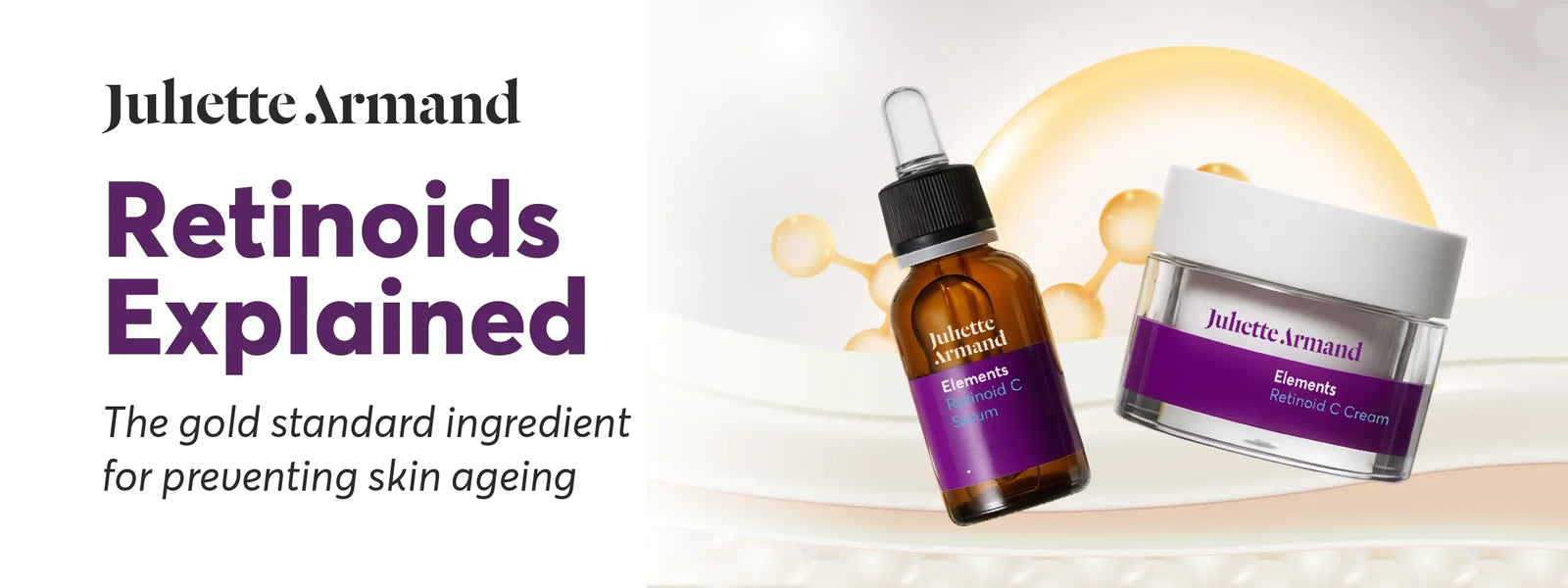
Beginner-level retinoid: Retinoid C Cream 0.5%
 Retinoid C Cream contains a 0.5% retinoid concentration within a moisturising cream formula.
It is intended to improve the appearance of fine lines, discolouration, acne scarring, uneven texture and reduced elasticity.
The formula contains 3-O-ethyl ascorbic acid, vitamin E and medium-molecular-weight hyaluronic acid. It also contains centella extract, panthenol, jojoba oil, apricot oil and shea butter.
These emollient, hydrating and soothing ingredients make the cream a logical starting point for adults who are new to retinoids or who prefer a richer format.
A lower concentration does not remove the possibility of irritation. New users should still begin with a limited frequency and increase use only when the skin remains comfortable.
Standard-strength retinoid: Retinoid C Serum 1%
 Retinoid C Serum contains a 1% retinoid concentration and antioxidant support.
The lightweight serum is intended for people seeking more intensive support for skin ageing, texture and uneven tone than an introductory cream may provide.
It has been formulated for practical wearability across different seasons. However, this does not remove the need for sun protection or mean that every person will tolerate daily application.
People moving from a 0.5% product should make the transition gradually rather than immediately using the stronger serum every day.
High-strength retinoid: Retinoid 3% Serum
 Retinoid 3% Serum is intended for more established concerns, including textural irregularities, pigmentation, wrinkles and blemishes.
Its 3% retinoid content is combined with antioxidant ingredients, including vitamins C and E.
This level is more appropriate for people who already have experience with retinoid skincare and have demonstrated good tolerance at lower strengths.
It should not be selected simply because the number is higher. Persistent redness, stinging, flaking or discomfort will interfere with consistent use and may worsen the concerns being treated.
Advanced users: Retinoid 10% Serum
 Retinoid 10% Serum contains a very high cosmetic retinoid percentage and is intended for intensive concerns such as established wrinkles, blemishes, pronounced pigmentation, age spots and uneven texture.
The formula also contains vitamin E and almond oil.
This is not a beginner product. It should be considered only for experienced users whose skin has already developed tolerance to lower-strength retinoids.
Professional guidance is strongly advised before introducing this concentration. It should not be used to accelerate results, combined with another retinoid or applied more often than directed.
What Are The Side Effects Of Retinoids?
Common retinoid side effects include:
-
Dryness
-
Tightness
-
Redness
-
Flaking
-
Mild stinging
-
Increased reactivity
-
Temporary worsening of breakouts
These effects are sometimes described collectively as retinisation, meaning the adjustment period that can occur when the skin is introduced to a retinoid.
Some mild dryness may occur, but severe inflammation is not a necessary part of the process and does not prove that the product is working.
Retinoid Irritation And Skin-Barrier Damage
Retinoids can disturb the skin barrier when the product is too strong, applied too frequently or combined with an unsuitable routine.
Warning signs include:
-
Persistent burning
-
Significant or spreading redness
-
Painful cracking
-
Swelling
-
Weeping or crusting
-
Worsening eczema or dermatitis
-
Stinging when bland moisturiser is applied
-
Skin that remains sore after the retinoid has been stopped
Stop using the product if these symptoms develop. Keep the routine simple while the barrier recovers and seek professional or medical advice where required.
Purging Vs Irritation
Purging describes a temporary increase in blemishes in areas where the person normally experiences breakouts. It may happen because changes in cell turnover bring existing follicular blockages to the surface more quickly.
Not every breakout is purging.
A widespread rash, itching, burning, swelling or blemishes in unusual areas may indicate irritation, allergy or dermatitis instead.
Continuing to apply a product to severely inflamed skin can prolong the problem.
Retinoids And Vulnerability To Ultraviolet Exposure
Retinoid use can make the skin more vulnerable when irritation, dryness or peeling is present. At the same time, ultraviolet exposure contributes to collagen breakdown and pigmentation, working against the reason many people use a retinoid.
Broad-spectrum sunscreen should be applied each morning and reapplied according to the product directions and level of exposure.
Do not apply retinoids to sunburnt skin.
What Can Be Used With Retinol Or Retinoids?
 Supportive ingredients can reduce discomfort and make long-term use more manageable.
Hyaluronic acid
Hyaluronic acid is a humectant that helps attract and retain water.
It does not perform the same action as a retinoid and can usually be used within the same routine to help manage dehydration and tightness.
Niacinamide
Niacinamide can support barrier function, hydration and a more even-looking complexion.
It is often a suitable partner for retinoid skincare, particularly where redness, oiliness or barrier weakness are concerns.
Ceramides
Ceramides are natural components of the skin barrier.
A moisturiser containing ceramides can be useful when introducing a retinoid or when the skin is prone to dryness.
Panthenol and centella
Panthenol and centella extract are commonly used to support hydration and skin comfort.
Retinoid C Cream already contains both ingredients alongside its retinoid, oils and shea butter.
Peptides
Peptides can generally be included within a retinoid routine. They may be particularly useful within routines focused on the appearance of firmness and skin quality.
Individual product directions should still be checked.
Vitamin C
Vitamin C and retinoids can be used within the same overall skincare programme.
However, independently layering a strong acidic vitamin C serum with a retinoid may be too irritating for a beginner. A simple option is to use vitamin C in the morning and the retinoid in the evening.
This is different from using a professionally formulated product in which a retinoid and a stabilised vitamin C derivative have already been combined at controlled levels.
What Should Not Be Mixed With Retinol Or Retinoids?
 The main concern is cumulative irritation.
Two ingredients do not need to react chemically with one another to create a problem. If both increase dryness, peeling or cell turnover, applying them together may overwhelm the skin barrier.
Salicylic acid
Salicylic acid is a beta hydroxy acid commonly used for oily, congested and blemish-prone skin.
Both salicylic acid and retinoids can cause dryness and irritation. Beginners should avoid introducing them at the same time or layering them during the same application.
Depending on the products and the person’s tolerance, a practitioner may recommend:
-
Using salicylic acid in the morning and the retinoid at night
-
Alternating them on different evenings
-
Using salicylic acid only once or twice a week
-
Temporarily stopping salicylic acid while retinoid tolerance develops
High-strength AHAs
Alpha hydroxy acids include glycolic, lactic and mandelic acid.
They exfoliate the outer layers of the skin and can be beneficial for texture and pigmentation. However, layering a high-strength AHA with a retinoid increases the likelihood of redness, peeling and barrier damage.
Inflamed skin should not be mistaken for faster rejuvenation.
People who need both ingredients may use them on separate days, but this should depend on the strength of the products and the condition of the skin.
Benzoyl peroxide
Benzoyl peroxide is used in acne routines because of its antimicrobial action.
It can oxidise and destabilise some traditional retinol and tretinoin formulations. The combination can also be particularly drying.
This does not mean that benzoyl peroxide is incompatible with every retinoid. Adapalene, for example, is available within prescription formulations specifically designed to combine it with benzoyl peroxide.
Do not independently layer a cosmetic retinol product with benzoyl peroxide unless compatibility has been confirmed by the manufacturer or an appropriate clinician. Separating them between morning and evening may be advised.
Other retinoids
Using several retinoid products within the same routine is unnecessary and increases irritation risk.
Do not combine a retinoid serum, retinol cream and prescription tretinoin unless this has been specifically directed by a prescriber.
Harsh scrubs and abrasive tools
Avoid aggressive scrubs, repeated facial brushing and abrasive cleansing devices while the skin is adjusting to a retinoid.
Physical friction can worsen inflammation and peeling.
Which Skin Types Are Suitable For Retinoids?
Retinoids may be suitable for many adult skin types, but suitability depends on the skin’s present condition, the concern being treated and the chosen formulation.
Skin type alone should not determine whether someone uses a retinoid.
Oily and blemish-prone skin
Retinoids may help regulate follicular cell turnover and reduce congestion.
However, using a retinoid alongside benzoyl peroxide, salicylic acid, strong glycolic acid and an aggressive cleanser can leave oily skin dehydrated and inflamed.
A controlled routine is usually more effective than applying every available acne active at once.
Dry skin
Dry skin may tolerate a retinoid when it is introduced slowly and supported with a suitable moisturiser.
A cream formula, such as Retinoid C Cream, may feel more comfortable than a lightweight serum. The complete formulation and concentration remain more important than texture alone.
Sensitive skin
Sensitive skin requires a cautious approach.
A mild retinyl ester mask or lower-strength cream may be more appropriate than a concentrated serum. Patch testing, limited frequency and a simple supporting routine may reduce the likelihood of irritation.
People with active rosacea, eczema or dermatitis should seek professional or medical advice before using a retinoid.
Pigmentation-prone skin
Retinoids may support a more even-looking complexion, but irritation can trigger or worsen post-inflammatory pigmentation.
This is particularly relevant for darker skin tones and anyone with a history of marks following inflammation.
Starting slowly and protecting the barrier are essential.
Mature or photodamaged skin
Adults with fine lines, rough texture, uneven tone and sun-related pigmentation may benefit from a carefully selected retinoid.
The correct starting level depends on previous use rather than age alone. Someone with mature but sensitive skin may need a gentler product than a younger adult who has used prescription retinoids for several years.
Does Young Skin Need Retinol?
Young skin should not automatically be placed on an anti-ageing retinoid routine.
During adolescence and early adulthood, collagen levels and cell turnover are generally higher than they are later in life. A person with healthy, balanced skin and no specific clinical concern is unlikely to gain meaningful preventative benefit from beginning a strong retinoid simply because it is popular online.
Unnecessary use can cause:
-
Dryness
-
Redness
-
Increased reactivity
-
Peeling
-
Barrier damage
-
Post-inflammatory pigmentation
-
Greater difficulty tolerating other necessary treatments
There is no universal age at which everyone should begin retinol. The decision should be based on a suitable indication, not a fear of ageing.
This does not mean that retinoids are always inappropriate for teenagers or young adults. Prescription retinoids are commonly used to manage acne, but this is a treatment decision rather than an anti-ageing measure. The product and routine should be selected for the diagnosed concern and used under suitable guidance.
For younger skin without acne or another clear indication, the priorities are usually:
-
Daily broad-spectrum sun protection
-
Gentle cleansing
-
Appropriate moisturising
-
Avoiding excessive exfoliation
-
Treating individual concerns rather than following trends
Who Should Avoid Retinoids Or Seek Advice First?
Retinoid use requires additional caution when the skin is inflamed, injured or undergoing another intensive treatment programme.
Professional or medical advice should be sought before use where there is:
-
Active eczema, dermatitis or rosacea
-
Significant skin-barrier damage
-
A history of severe reactions to vitamin A
-
Prescription acne treatment
-
A planned chemical peel, laser or resurfacing procedure
-
Recent sunburn
-
Use of another prescription retinoid
-
Pregnancy, plans to become pregnant or breastfeeding
Topical retinoids are generally avoided during pregnancy as a precaution. Anyone who is pregnant, trying to conceive or breastfeeding should discuss vitamin A skincare with an appropriate healthcare professional.
How To Introduce A Retinoid Safely
Begin with a formulation and concentration appropriate for your previous experience.
For many new users, this means starting with a gentle mask or 0.5% cream rather than a high-strength serum.
A cautious introduction may involve:
-
Applying the retinoid once or twice a week.
-
Using a small amount on clean, dry skin.
-
Avoiding the eyelids, lip corners and creases around the nose unless the product is specifically intended for those areas.
-
Following with moisturiser.
-
Increasing frequency gradually only when the skin remains comfortable.
-
Avoiding the introduction of another strong active during the same period.
-
Applying broad-spectrum sunscreen every morning.
People with dry or sensitive skin may use the moisturiser sandwich method: moisturiser, retinoid, then another light layer of moisturiser.
More product does not produce proportionally better results. Applying too much mainly increases the chance of irritation.
Retinoids And Professional Skin Treatments
Retinoids can affect how the skin responds to professional procedures.
Practitioners should be informed about all vitamin A products used at home, including cosmetic retinol, retinaldehyde, prescription tretinoin and oral isotretinoin.
Retinoids may need to be paused before and after procedures such as:
-
Chemical peels
-
Laser resurfacing
-
Dermabrasion
-
Waxing
-
Other treatments that disturb or exfoliate the skin barrier
The appropriate interval depends on the product, treatment intensity, skin condition and practitioner protocol.
Do not stop prescribed medication without speaking to the prescriber.
How Long Do Retinoids Take To Work?
Hydration and surface texture may begin to look different within several weeks, but changes in fine lines, pigmentation and skin structure usually require longer.
Meaningful results depend on consistency and may take several months.
Retinoid skincare should be viewed as a long-term programme rather than a rapid corrective treatment. Increasing the percentage too quickly or using the product every night before the skin is ready can delay progress by causing inflammation.
Choosing The Right Retinoid
The right product is the one that addresses the person’s concerns at a strength they can tolerate consistently.
A practical Juliette Armand progression may include:
-
Gentle introduction: Lifting Mask or Chlorophyll Firming Mask
-
New retinoid user: Retinoid C Cream 0.5%
-
Established user: Retinoid C Serum 1%
-
Experienced user with more persistent concerns: Retinoid 3% Serum
-
Advanced user under professional guidance: Retinoid 10% Serum
-
Practitioner-led resurfacing: Elements Grand Retinoid Therapy
This should not be treated as a compulsory ladder. Some people may remain on a lower-strength product because it provides the desired results without irritation.
Conclusion
Retinoids can improve several visible signs of skin ageing because they influence cell renewal, pigmentation, follicular activity and collagen-related processes.
Their effectiveness does not mean that the strongest product is automatically the right choice. The best results usually come from matching the retinoid to the skin, introducing it gradually and maintaining a routine that supports the skin barrier.
Gentler options such as retinyl palmitate masks or Retinoid C Cream may suit first-time users.
More experienced users may progress to Retinoid C Serum, Retinoid 3% Serum or, with appropriate professional guidance, Retinoid 10% Serum. Clients requiring more controlled and targeted resurfacing may be better suited to the practitioner-led Elements Grand Retinoid Therapy.
Young, healthy skin does not need a strong anti-ageing retinoid as a preventative trend. Where acne or another recognised concern is present, vitamin A may still have a valid role, but the treatment should be selected for that condition.
Whatever the product level, gradual introduction, daily sun protection and careful management of other active ingredients remain central to safe and consistent retinoid use.