Best CryoPen for Your Clinic: Which CryoPen Model Should You Choose?

If you are searching for the best CryoPen, there is an important point to understand from the outset: there is no single CryoPen model that is automatically better than the others.
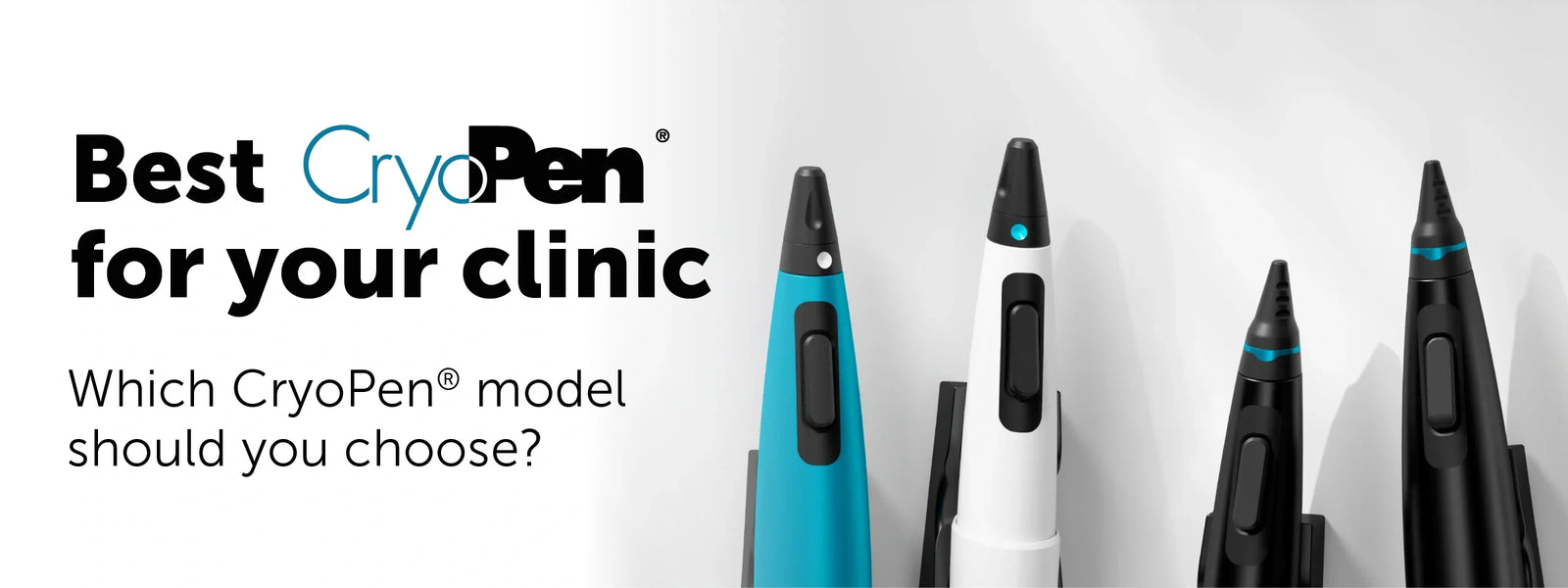
The current exclusive CryoPen range available through IvanMed includes the CryoPen M, CryoPen XPS, CryoPen O+ and CryoPen XP.
All four are professional CryoPen devices designed for the controlled treatment of suitable benign skin lesions. The main differences come down to your professional qualification, applicator configuration and the device features that matter most to you, rather than one model treating a completely different range of lesions from another. Note that Accurett is also sold by us and you can speak to our team about it.
For example, many medical practitioners choose the CryoPen M because it meets their requirements perfectly. Others may prefer XPS or XP because they want greater precision when working around sensitive areas and more efficient use of nitrous oxide.
This guide will help you understand the differences without unnecessarily complicating the decision.
Want help choosing before you continue? Download the full CryoPen brochure and provide your professional details. A CryoPen specialist will review your requirements and contact you to discuss the most suitable option for your clinic.
Which CryoPen Is Best for Me?
The easiest way to narrow down your choice is to first establish which models are available for your professional qualification, then consider the device features you actually need.
|
CryoPen model |
Who is it for? |
Key specifications |
Why might you choose it? |
|
CryoPen M |
All eligible practitioner groups |
2 applicators, covering 1-6 mm; uses 8g N₂O cartridges |
A professional CryoPen suitable for practitioners who do not specifically require the additional characteristics of XPS |
|
CryoPen XPS |
All eligible practitioner groups |
2 applicators, covering 1-4 mm; uses 8g N₂O cartridges |
Particularly suited to practitioners wanting greater precision around sensitive areas and improved nitrous oxide efficiency |
|
CryoPen O+ |
Nurses and medical practitioners |
4 applicators, covering 1-20 mm; uses 16g N₂O cartridges |
A professional CryoPen option for eligible nurses and medical practitioners wanting a four-applicator configuration |
|
CryoPen XP |
Medical practitioners |
4 applicators, covering 1-20 mm; uses 16g N₂O cartridges |
Particularly suited to medical practitioners wanting greater precision around sensitive areas and improved nitrous oxide efficiency |
There is deliberately no overall winner.
A more expensive or differently specified CryoPen is not automatically the best choice for your clinic.
The right model is the one that meets your professional eligibility and gives you the features you actually want.
What Is CryoPen?
CryoPen is a professional cryosurgery system designed for the controlled treatment of suitable benign skin lesions.
It delivers a highly targeted jet of nitrous oxide at approximately -89°C to freeze unwanted tissue while allowing the practitioner to control the treatment area.
The pen-style application helps practitioners target the lesion accurately rather than unnecessarily freezing a wide area of surrounding healthy skin.
CryoPen devices use specially designed applicators to deliver nitrous oxide precisely to the treatment area. Different models offer different applicator configurations and treatment diameters, allowing practitioners to choose the device that best suits the way they intend to work.
CryoPen can be used for commonly encountered benign lesions such as skin tags, solar lentigines or age spots, warts, verrucae and cherry angiomas, subject to practitioner qualification, training, lesion assessment and insurance.
It is important to distinguish between what a CryoPen can treat and what an individual practitioner is professionally permitted to treat.
The device may be suitable for a particular benign lesion, but the practitioner still needs the appropriate qualification, competence, training and insurance.
What Should You Look for When Choosing a CryoPen?
Choosing between CryoPen M, XPS, O+ and XP does not need to become a complicated comparison of individual skin lesions.
Instead, focus on four things.
1. Your Professional Qualification
Your qualification determines which CryoPen models are available to you.
The practitioner groups we work with include:
-
Medical Practitioners
-
Nurses/Aesthetics Practitioners
-
Level 3 in Beauty or Equivalent
CryoPen M and XPS are available across the eligible practitioner groups.
CryoPen O+ is available to eligible nurses and medical practitioners.
CryoPen XP is intended for medical practitioners.
2. Precision and the Way You Want to Work
Every CryoPen is designed around precise application of nitrous oxide.
For practitioners who place particular importance on greater precision when working around sensitive areas, XPS and XP may be especially worth considering.
This does not mean that M or O+ lack precision. Precision is central to the CryoPen system itself.
The difference is whether the additional characteristics of XPS or XP are important enough to influence your purchase.
3. Applicator Configuration
The models also differ in their applicator configuration.
CryoPen M uses two applicators covering treatment diameters from 1-6 mm.
CryoPen XPS also uses two applicators, covering 1-4 mm.
CryoPen O+ and CryoPen XP each provide four applicators, covering treatment diameters from 1-20 mm.
These measurements provide a useful technical distinction between the devices without suggesting that one CryoPen is simply better than another.
4. Your Professional Scope and Insurance
Whichever CryoPen you choose, you should confirm that your professional insurance covers the treatments you intend to offer.
Your qualification also determines which lesions fall within your individual scope of practice.
That distinction is more important than trying to divide individual CryoPen models according to specific lesion types.
1. CryoPen M: A Professional CryoPen for All Practitioner Groups
The CryoPen M is one of the core devices within the CryoPen range and can be used by appropriately qualified practitioners across beauty, aesthetics, nursing and medical practice.
It should not be viewed as a device only for beginners or as a lesser version of another CryoPen.
Medical practitioners regularly choose CryoPen M because it provides the functionality they need without requiring additional device characteristics that may not be important to their practice.
CryoPen M Specifications
CryoPen M comes with two applicators covering treatment diameters from 1-6 mm and uses 8g nitrous oxide cartridges.
Who Is CryoPen M For?
CryoPen M can be suitable for:
-
Level 3 Beauty practitioners or equivalent
-
Aesthetics practitioners
-
Nurses
-
Medical practitioners
Eligibility remains subject to the appropriate training, professional scope and insurance requirements.
What Can CryoPen M Treat?
CryoPen M can be used for a broad range of suitable benign skin lesions within the practitioner's professional scope.
These may include skin tags, solar lentigines, warts, verrucae, cherry angiomas and other appropriate benign lesions.
You should not choose or reject CryoPen M because you believe another model automatically gives you access to an entirely different collection of lesion treatments.
The practitioner's qualification and competence determine what they can personally treat.
Who Should Choose CryoPen M?
CryoPen M is worth considering if you want a professional CryoPen and do not specifically require the additional characteristics that may lead you towards XPS.
Its two applicators provide treatment diameters from 1-6 mm, while its compact 8g cartridge format may also suit the way you intend to use CryoPen within your practice.
It can be equally relevant to an experienced medical practitioner or somebody introducing CryoPen into an existing beauty or aesthetics clinic.
Best suited to: Practitioners across the eligible professional groups looking for a professional CryoPen with a two-applicator, 1-6 mm configuration.
See the CryoPen M in the Full Brochure
2. CryoPen XPS: Greater Precision and Nitrous Oxide Efficiency
The CryoPen XPS is also available across the eligible practitioner groups.
The main reason to consider XPS over M should not be because you believe it treats a completely different collection of lesions.
Instead, XPS is particularly attractive to practitioners who value greater precision when working around sensitive areas and more efficient use of nitrous oxide.
CryoPen XPS Specifications
CryoPen XPS comes with two applicators covering treatment diameters from 1-4 mm and uses 8g nitrous oxide cartridges.
Who Is CryoPen XPS For?
CryoPen XPS can be suitable for:
-
Level 3 Beauty practitioners or equivalent
-
Aesthetics practitioners
-
Nurses
-
Medical practitioners
As with CryoPen M, practitioners must meet the appropriate training, scope-of-practice and insurance requirements.
What Can CryoPen XPS Treat?
XPS can be used for suitable benign CryoPen treatments within the practitioner's permitted professional scope.
The distinction is therefore primarily about how you want to work with the device rather than access to a separate category of lesions.
Why Choose CryoPen XPS?
CryoPen XPS is particularly worth considering if precision is a major priority for your clinic.
This may be relevant when working around sensitive treatment areas where increased control is valuable.
Its efficient use of nitrous oxide may also appeal to practitioners looking closely at consumable use within their CryoPen service.
Best suited to: Practitioners across the eligible professional groups who particularly value precision around sensitive areas and efficient nitrous oxide use.
Compare CryoPen XPS Packages in the Full Brochure
3. CryoPen O+: Four-Applicator CryoPen for Nurses and Medical Practitioners
The CryoPen O+ is available to eligible nurses and medical practitioners.
As with the rest of the CryoPen range, O+ should not be considered better simply because it has a different applicator and cartridge configuration.
The relevant question is whether its configuration suits your professional background and the way you intend to use CryoPen.
CryoPen O+ Specifications
CryoPen O+ comes with four applicators covering treatment diameters from 1-20 mm and uses 16g nitrous oxide cartridges.
This gives eligible practitioners a different applicator and cartridge configuration from M and XPS without changing the fundamental CryoPen treatment principle.
Who Is CryoPen O+ For?
CryoPen O+ is available to eligible:
-
Nurses
-
Medical practitioners
Practitioners should still ensure that the CryoPen treatments they intend to offer sit within their professional scope and insurance.
What Can CryoPen O+ Treat?
CryoPen O+ can be used for a broad range of suitable benign lesions within the practitioner's competence and professional scope.
As with M, XPS and XP, lesion suitability should be assessed individually.
The device model does not remove the practitioner's responsibility to identify whether a lesion is appropriate for cryotherapy.
Who Should Choose CryoPen O+?
CryoPen O+ is worth considering if you are an eligible nurse or medical practitioner and prefer a CryoPen with four applicators covering 1-20 mm and a 16g cartridge format.
Those are useful practical differences when comparing the devices, but they should not be interpreted as meaning that O+ is automatically a better CryoPen.
Best suited to: Eligible nurses and medical practitioners looking for a four-applicator CryoPen using 16g cartridges.
See the CryoPen O+ Package in the Full Brochure
4. CryoPen XP: Precision and Nitrous Oxide Efficiency for Medical Practitioners
The CryoPen XP is intended for medical practitioners.
Practitioners may choose it because they particularly value greater precision around sensitive areas and improved nitrous oxide efficiency.
It should not be interpreted as a CryoPen that simply treats more lesions than the other models.
CryoPen XP Specifications
CryoPen XP comes with four applicators covering treatment diameters from 1-20 mm and uses 16g nitrous oxide cartridges.
Who Is CryoPen XP For?
CryoPen XP is intended for eligible medical practitioners.
As with every CryoPen model, practitioners must still work within their professional competence and insurance.
What Can CryoPen XP Treat?
CryoPen XP can be used across a broad range of suitable benign skin lesions within the medical practitioner's professional scope.
The main reason for choosing XP should therefore relate to the characteristics of the device rather than assuming another CryoPen is incapable of performing a particular benign lesion treatment.
Why Choose CryoPen XP?
Cryopen XP is particularly relevant to medical practitioners who place a high value on precision, especially around sensitive treatment areas.
Its efficient use of nitrous oxide may also be important to medical practitioners considering consumable efficiency as part of their CryoPen service.
Its four-applicator, 1-20 mm configuration and 16g cartridge format provide another practical distinction when comparing it with M and XPS.
Best suited to: Medical practitioners who particularly value precision around sensitive areas, nitrous oxide efficiency and a four-applicator configuration.
Explore CryoPen XP in the Full Brochure
CryoPen M vs XPS vs O+ vs XP
When comparing CryoPen models, avoid thinking of them as a simple ladder from basic to advanced.
A medical practitioner can choose CryoPen M just as legitimately as they can choose XP.
The useful comparison is:
|
CryoPen M |
CryoPen XPS |
CryoPen O+ |
CryoPen XP |
|
|
Level 3 Beauty or Equivalent |
Yes, subject to eligibility |
Yes, subject to eligibility |
No |
No |
|
Aesthetics Practitioner |
Yes, subject to eligibility |
Yes, subject to eligibility |
Dependent on nursing/medical eligibility |
No |
|
Nurse |
Yes |
Yes |
Yes |
No |
|
Medical Practitioner |
Yes |
Yes |
Yes |
Yes |
|
Applicators |
2 |
2 |
4 |
4 |
|
Applicator coverage |
1-6 mm |
1-4 mm |
1-20 mm |
1-20 mm |
|
Cartridge format |
8g N₂O |
8g N₂O |
16g N₂O |
16g N₂O |
|
Main reason to consider |
Straightforward professional CryoPen configuration |
Greater precision around sensitive areas and improved N₂O efficiency |
Four-applicator configuration for eligible nurses and medics |
Greater precision around sensitive areas and improved N₂O efficiency for medical practitioners |
Professional eligibility, treatment scope and insurer requirements should always be confirmed before treatment.
Which CryoPen Is Best for a Medical Practitioner?
Medical practitioners have access to the broadest choice within the CryoPen range.
Importantly, being medically qualified does not mean that you automatically need CryoPen XP.
Many medical practitioners choose CryoPen M because it already meets their requirements.
A medical practitioner could therefore consider:
CryoPen M if they want a two-applicator CryoPen covering 1-6 mm and do not specifically require the additional characteristics associated with XPS.
CryoPen XPS if greater precision around sensitive areas and improved nitrous oxide efficiency are particularly important.
CryoPen O+ if they prefer a four-applicator configuration covering 1-20 mm with a 16g cartridge format.
CryoPen XP if they want the precision and nitrous oxide efficiency characteristics of XP alongside a four-applicator, 1-20 mm configuration.
The decision is about preference and requirements, not about one device being more clinically legitimate than another.
Which CryoPen Is Best for a Nurse or Aesthetics Practitioner?
The answer depends first on the practitioner's exact professional background.
A registered nurse and a non-medical aesthetics practitioner may both work within aesthetics, but their professional eligibility is not necessarily identical.
CryoPen M and XPS are available across the relevant eligible practitioner groups.
Registered nurses may also be eligible for CryoPen O+.
CryoPen XP remains within the medical practitioner pathway.
Where there is any uncertainty, your professional qualification can be checked before purchase.
Which CryoPen Is Best for Someone with Level 3 Beauty or Equivalent?
For somebody with Level 3 Beauty or an equivalent qualification, the main CryoPen choices are CryoPen M and CryoPen XPS, subject to current eligibility and insurance requirements.
The decision between them does not need to be based on which lesions you plan to treat.
CryoPen M uses two applicators covering 1-6 mm, while XPS uses two applicators covering 1-4 mm.
XPS may particularly appeal to practitioners who place greater importance on precision around sensitive areas and more efficient nitrous oxide use.
If those characteristics are not important to your requirements, CryoPen M remains a professional option.
Qualification does not remove the need for lesion identification skills, treatment training or suitable insurance.
If a lesion is uncertain, suspicious or outside your professional scope, it should not be treated simply because you have access to a CryoPen.
What Skin Lesions Can CryoPen Treat?
The CryoPen range is designed for the controlled cryotherapy treatment of appropriate benign skin lesions.
Common treatment presentations include:
-
Skin tags
-
Solar lentigines, including age and sun spots
-
Warts
-
Verrucae
-
Cherry angiomas
-
Seborrhoeic keratoses
-
Molluscum contagiosum
-
Other appropriate benign lesions
The important distinction is that these should be considered CryoPen treatments, rather than dividing each lesion between individual CryoPen models.
What an individual practitioner can treat depends on their professional qualification, competence, training and insurance.
Some lesion categories also sit within a medical treatment pathway or require additional medical assessment.
Actinic keratoses and genital warts, for example, require appropriate medical management.
Melanocytic lesions such as moles also require particular care.
The central rule is simple:
If you are not confident that you know what the lesion is, do not treat it.
Lesion recognition is one of the most important skills in professional cryosurgery.
A practitioner needs to understand not only how to use CryoPen but also when a lesion should be referred rather than frozen.
Can CryoPen Be Used to Remove Moles?
CryoPen can be used in the management of appropriate benign moles, but a mole should never be treated simply because it appears unwanted.
Melanocytic lesions require appropriate assessment.
For non-medical practitioners, appropriate medical clearance is required before proceeding with a mole that has been confirmed as benign.
Where there is any uncertainty about the nature of a mole or another pigmented lesion, it should be assessed before treatment.
Removing a suspicious lesion without appropriate assessment could delay the diagnosis of a more serious condition.
Clinics that regularly receive enquiries about moles can also consider incorporating an appropriate lesion-assessment or dermatologist-review pathway into their service.
Is CryoPen Training Included?
Yes. CryoPen packages include accredited training to help practitioners develop the knowledge and practical skills required to use the device appropriately.
Professional CryoPen use involves more than learning how to activate the device.
Training covers the principles required to use cryotherapy appropriately, including lesion assessment, treatment technique, cartridge and device handling, safe treatment parameters, client consultation and post-treatment considerations.
The training journey begins with online theory, followed by practical training at an appropriate training venue.
The practical element gives practitioners the opportunity to develop and demonstrate the correct use of the CryoPen and appropriate treatment technique.
CryoPen trainees can also gain CPD points as part of the training pathway.
Correct lesion identification and correct application are both central to safe and effective CryoPen treatment, which is why training forms an important part of the package.
What Happens After You Buy a CryoPen?
CryoPen becomes part of an ongoing professional treatment service rather than simply being a one-off equipment purchase.
You will need the correct cartridges for your particular device, appropriate storage and handling, suitable consultation procedures, professional insurance and continued attention to lesion assessment.
Cartridge format differs between models.
CryoPen M and XPS use 8g nitrous oxide cartridges, while O+ and XP use 16g nitrous oxide cartridges.
Cartridge and device temperature can also affect performance.
Nitrous oxide pressure performs most predictably when the device and cartridge are maintained at an appropriate working temperature.
A device that has been stored in a cold environment can deliver weaker gas pressure until both the CryoPen and cartridge return to the correct temperature.
Correct cartridge installation is also important to minimise gas loss and maintain consistent operation.
These practical considerations are covered during training so practitioners understand how to obtain reliable performance from their CryoPen during day-to-day clinic use.
Is CryoPen Worth Adding to a Clinic?
That depends on the clinic and its patients, but CryoPen can complement a wide range of beauty, aesthetics and medical services.
Benign lesions such as skin tags, age spots and warts are common concerns, and many people choose to seek private treatment where appropriate.
CryoPen also has relatively low consumable requirements compared with many larger aesthetic systems and does not require a large treatment room or substantial equipment footprint.
For the right clinic, cryotherapy can therefore sit naturally alongside existing skin and aesthetics treatments.
The commercial question should not simply be:
“How much does a CryoPen cost?”
It is also worth asking:
“Is there demand for CryoPen treatments among my existing and prospective clients?”
If there is, the next step is establishing which CryoPen models you are professionally eligible for and which device characteristics matter most to you.
So, Which Is the Best CryoPen?
There is no single CryoPen that every practitioner should buy.
CryoPen M is available across the eligible practitioner groups and provides a two-applicator, 1-6 mm configuration using 8g nitrous oxide cartridges.
CryoPen XPS is also available across the eligible practitioner groups and is particularly relevant to those wanting greater precision around sensitive areas and improved nitrous oxide efficiency.
CryoPen O+ is available to eligible nurses and medical practitioners and provides four applicators covering 1-20 mm with a 16g cartridge format.
CryoPen XP is designed for medical practitioners who particularly value greater precision around sensitive areas and improved nitrous oxide efficiency, alongside a four-applicator, 1-20 mm configuration.
The decision should therefore not be based on the idea that one CryoPen is simply better or capable of treating more than another.
Start with your professional qualification, establish the models available to you, and then decide which device characteristics best suit the way you want to work.
Not Sure Which CryoPen to Choose?
You do not need to make the decision from specifications alone.
Download the full CryoPen brochure and provide us with your professional background and clinic requirements.
A CryoPen specialist will contact you to discuss the available models, your qualification and the features that are most relevant to your practice.
Frequently Asked Questions
What is the best CryoPen to buy?
There is no single best CryoPen for every practitioner.
The first step is establishing which models you are eligible for based on your professional qualification.
From there, compare practical characteristics such as applicator configuration, treatment diameter, cartridge format, precision and nitrous oxide efficiency rather than assuming one CryoPen treats more lesions than another.
What is the best CryoPen for a beauty therapist?
For somebody with Level 3 Beauty or an equivalent qualification, CryoPen M and CryoPen XPS are the main models to consider, subject to current training eligibility and insurance requirements.
CryoPen M has two applicators covering 1-6 mm, while XPS has two covering 1-4 mm.
XPS may particularly appeal to practitioners who want greater precision around sensitive areas and improved nitrous oxide efficiency.
Can a nurse use CryoPen?
Yes. Suitably qualified and trained nurses can use eligible CryoPen models within their professional scope and insurance.
CryoPen M, XPS and O+ may be available to nurses, depending on current eligibility requirements.
Can an aesthetics practitioner use CryoPen?
CryoPen may be suitable for appropriately qualified aesthetics practitioners.
CryoPen M and XPS are the main models to consider where the practitioner meets the relevant qualification, training and insurance requirements.
What qualifications do you need for CryoPen?
CryoPen practitioners may come from medical practice, nursing, aesthetics or a Level 3 Beauty or equivalent background.
The models available to you depend on your professional qualification, so eligibility should be confirmed before purchase.
Do different CryoPen models treat different lesions?
The CryoPen range is designed for appropriate benign lesion treatment.
Rather than choosing a device on the assumption that one model treats an entirely different lesion list, consider your professional eligibility and the technical characteristics of each CryoPen.
Your qualification, competence, training and insurance determine which treatments you can personally provide.
What is the difference between CryoPen M and XPS?
Both CryoPen M and XPS are available across the eligible practitioner groups and both use 8g nitrous oxide cartridges.
CryoPen M comes with two applicators covering 1-6 mm.
CryoPen XPS comes with two applicators covering 1-4 mm and is particularly worth considering for practitioners who place greater importance on precision around sensitive areas and efficient nitrous oxide use.
What is the difference between CryoPen O+ and XP?
Both use a four-applicator configuration covering treatment diameters from 1-20 mm and use 16g nitrous oxide cartridges.
The key differences for buyers are practitioner eligibility and device preference.
O+ is available to eligible nurses and medical practitioners, while XP is intended for medical practitioners and is particularly relevant to those wanting greater precision around sensitive areas and improved nitrous oxide efficiency.
What is the difference between CryoPen XPS and XP?
Both are particularly relevant where precision and nitrous oxide efficiency are important, but they have different configurations and practitioner pathways.
XPS has two applicators covering 1-4 mm, uses 8g cartridges and is available across the eligible practitioner groups.
XP has four applicators covering 1-20 mm, uses 16g cartridges and is intended for medical practitioners.
What skin lesions can CryoPen treat?
CryoPen can be used for suitable benign skin lesions including skin tags, solar lentigines or age spots, warts, verrucae, cherry angiomas, seborrhoeic keratoses, molluscum contagiosum and other appropriate benign lesions.
Some lesions require medical management or assessment, and uncertain or suspicious lesions should not be treated until appropriately evaluated.
Can CryoPen remove age spots?
CryoPen can be used for suitable solar lentigines, commonly known as age spots or sun spots.
Pigmentation must be assessed correctly before treatment because not every form of pigmentation should be treated with cryotherapy.
Melasma, for example, should not be treated as a solar lentigo.
Can CryoPen remove skin tags?
Yes. Skin tags are one of the common benign lesions treated with CryoPen.
Treatment suitability still depends on correct lesion identification and an appropriate client consultation.
Can CryoPen remove warts and verrucae?
CryoPen can be used on suitable warts and verrucae.
Viral lesions can sometimes require more than one treatment because treatment response is influenced by the freezing procedure and the body's response to the underlying virus.
Can CryoPen remove moles?
Appropriate benign moles may be treated, but melanocytic lesions require careful assessment.
Non-medical practitioners require appropriate medical clearance before treating a mole.
Any suspicious or uncertain lesion should be referred rather than treated.
Is the most expensive CryoPen automatically the best?
No. Price should not be used as a simple measure of which CryoPen is best.
Medical practitioners regularly choose CryoPen M, while other practitioners may choose XPS, O+ or XP because their particular device configuration or features better suit their requirements.
The best choice is the CryoPen that meets your professional eligibility and gives you the characteristics you require.
Is CryoPen training included?
Yes. CryoPen packages include accredited training, with theory completed online and practical training provided at an appropriate training venue.
How do I know which CryoPen I qualify for?
The easiest option is to download the CryoPen brochure and provide your professional qualification when enquiring.
A CryoPen specialist can then confirm which models are available to you and help you understand the differences before you purchase.
Choose the CryoPen That Fits Your Practice
Searching for the best CryoPen can make the range appear more complicated than it needs to be.
You do not need to decide which device is supposedly the most powerful or which one can treat the most lesions.
Start with your professional qualification.
That will establish the CryoPen models available to you.
You can then compare the characteristics that genuinely matter to your practice, including applicator configuration, cartridge format, precision and nitrous oxide efficiency.
For some practitioners, CryoPen M will be exactly the right choice.
For others, XPS, O+ or XP will better match their preferences.
Download the full CryoPen brochure today and a CryoPen specialist will contact you to help you choose the appropriate model for your clinic.